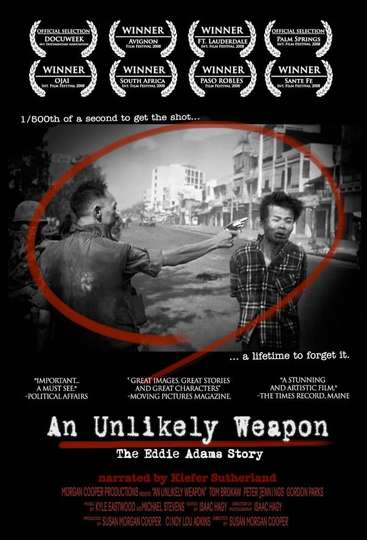

Plot: The weapon in question is not a firearm (as might be expected) but a camera: from the 1950s through the early 21st century, photojournalist and sports photographer Eddie Adams (1933-2004) caught a series of indelible images through his lens that ... Read More
Latest on An Unlikely Weapon
To be eligible for the Academy Awards, a documentary feature must play theatrically, at least two showings a day, for at least a week in both Los Angeles County and the borough of Manhattan. (For documentary shorts, it only has to play in one location or...
Your Reviews
Filmmaker Susan Morgan Cooper weaves history, art and masterful storytelling to create a cinematic tapestry that is both disturbing and inspiring. Shot over four decades, An Unlikely Weapon provides ... a rare, behind-the-scenes look at a war and a nation in turmoil. Adams' personal life seems to parallel the hell he witnesses on the front line through his camera lens, and ironically, leaves a blood stain on his own soul that he can never seem to wash away. Adams' camera was his most powerful weapon, but it failed to protect him from himself. In 1968, while covering the war for the Associated Press, Eddie Adams photographed a Saigon police chief, General Nguyen Ngoc Loan, shooting a Vietcong guerilla point blank. Ironically, it was Adams' shot that was heard around the world, taken at 1/500th of a second! The photo brought Adams' fame and a Pulitzer, but the man he had vilified haunted him. Adams would later say, "Two lives were destroyed that day - the victim's and the general." Yet others would say, three lives were destroyed. Eddie Adams, like most artists, was tortured by his need for perfection. Nothing he did ever satisfied him. He carved out many careers, shooting covers for Life, Time, and even Penthouse. Yet, somehow, Adams was always pulled back into documenting wars - 13 all together. Finally he hit the wall and couldn't take it anymore. He began shooting celebrities because "it doesn't take anything from you." Adams was comfortable with kings and coal miners. During his time with Parade Magazine, he photographed Clint Eastwood, Louis Armstrong, Mother Teresa, and Pope John Paul. The film is a tribute to a man who is easy to respect for his images and raw honesty. Narrated by Kiefer Sutherland with a beautiful score by Kyle Eastwood (Clint Eastwood's son), I simply loved this film. Full Review

Amanda Seyfried Naked: 'Lovelace' Nude Scenes Planned for Star
Jean Dujardin's Robert De Niro Impression: 'Artist' Star Shows Off in Front of Legend at Awards Dinner
'Bridesmaids' Sequel: Waiting for Kristen Wiig?
Israel Baker Dead: Violinist for Alfred Hitchcock's 'Psycho' Score Dies at 92 (VIDEO)