













51
 Watch on Tubi

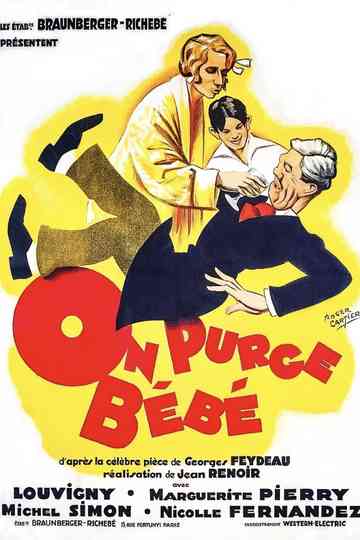
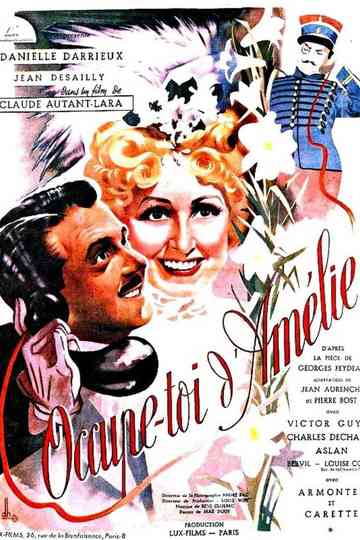
Georges-Léon-Jules-Marie Feydeau (8 December 1862 – 5 June 1921) was a French playwright of the Belle Époque era, remembered for his farces, written between 1886 and 1914. Feydeau was born in Paris to middle-class parents and raised in an artistic and literary environment. From an early age he was fascinated by the theatre, and as a child he wrote plays and organised his schoolfellows into a drama group. In his teens he wrote comic monologues and moved on to writing longer plays. His first full-length comedy, Tailleur pour dames ('Ladies' tailor'), was well received, but was followed by a string of comparative failures. He gave up writing for a time in the early 1890s and studied the methods of earlier masters of French comedy, particularly Eugène Labiche, Alfred Hennequin and Henri Meilhac. With his technique honed, and sometimes in collaboration with a co-author, he wrote seventeen full-length plays between 1892 and 1914, many of which have become staples of the theatrical repertoire in France and abroad. They include L'Hôtel du libre échange ('The Free Exchange Hotel', 1894), La Dame de chez Maxim ('The lady from Maxim's', 1899), La Puce à l'oreille ('A flea in her ear', 1907) and Occupe-toi d'Amélie! ('Look after Amélie', 1908). The plays of Feydeau are marked by closely observed characters, with whom his audiences could identify, plunged into fast-moving comic plots of mistaken identity, attempted adultery, split-second timing and a precariously happy ending. After the great success they enjoyed in his lifetime they were neglected after his death, until the 1940s and 1950s, when productions by Jean-Louis Barrault and the Comédie-Française led a revival of interest in his works, at first in Paris and subsequently worldwide. Feydeau's personal life was marred by depression, unsuccessful gambling and divorce. In 1919 his mental condition deteriorated sharply and he spent his final two years in a sanatorium at Rueil (now Rueil-Malmaison), near Paris. He died there in 1921 at the age of fifty-eight. Feydeau was born at his parents' house in the Rue de Clichy, Paris, on 8 December 1862. His father, Ernest-Aimé Feydeau (1821–1873), was a financier and a moderately well-known writer, whose first novel Fanny (1858) was a succès de scandale and earned him some notoriety. It was condemned from the pulpit by the Archbishop of Paris, and consequently sold in large numbers and had to be reprinted; Ernest dedicated the new edition to the archbishop. Feydeau's mother was Lodzia Bogaslawa, née Zelewska (1838–1924) known as "Léocadie". When she married Ernest Feydeau in 1861, he was a forty-year-old childless widower and she was twenty-two. She was a famous beauty, and rumours spread that she was the mistress of the Duc de Morny or even the Emperor Napoleon III and that one of them was the father of Georges, her first child. In later life Léocadie commented, "How can anyone be stupid enough to believe that a boy as intelligent as Georges is the son of that idiotic emperor!" She was more equivocal about her relationship with the duke, and Georges later said that people could think Morny his father if they wanted to. ... Source: Article "Georges Feydeau" from Wikipedia in English, licensed under CC-BY-SA.

Moviefone is your ultimate guide to what's new in theaters and streaming on any screen.